
on tomboyx.com
As a general matter, we wanted to increase add to cart rate on product pages because it was where we saw the biggest leak in the funnel. Separate from that, customers would often lament to us that we had sold out of their sizes too fast.
Could one solution solve both?
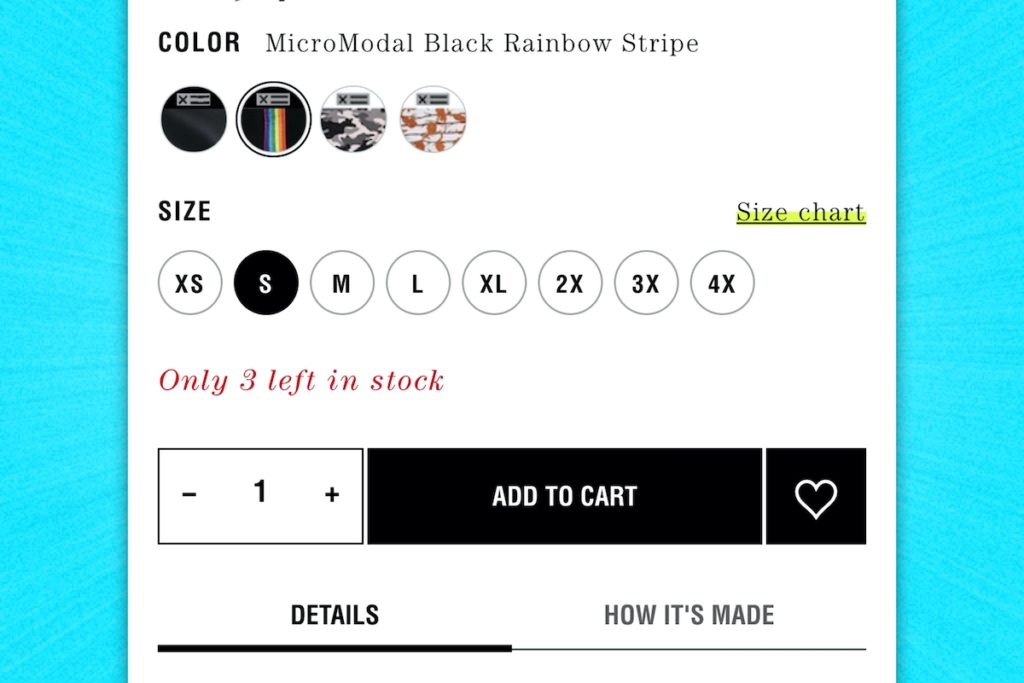
I determined we should use scarcity messaging. Scarcity is one of Robert Cialdini’s universal Principles of Persuasion. You see it a lot these days with the fashion “drop” models too.
We hypothesized that scarcity messaging would not only increase add to cart rate from the product page, but inform the customer when there was low stock on an item so they should move quickly if they really wanted it.
Results: Add to cart rate did not increase, but abandoned cart rate decreased, and revenue increased 10% over the control.
My role
I assessed the problem and recommended the scarcity solution.
I wrote the trigger, logic, and expected behavior of the experience: this message should display on a per variant basis—if the customer selects XL, and XL has inventory below a certain level, display the message. With the help of my team, I made decisions for each possible outcome—What happens when they select a different size after that? What happens if it’s a one-size product? A digital product?
I mocked up where this message would go on the product page and designed different variations for testing in the future.
The most important requirement for me was that the information was true. So, we had to get our messaging platform (Dynamic Yield) to read Shopify inventory level which it did not do by default and our devs were not able to help with. I accomplished this using Google Tag Manager.
Learnings
Results: Add to cart rate did not increase, but abandoned cart rate decreased, and revenue increased 10% over the control.
We were happy to see a decrease in abandoned carts and an increase in revenue. And we solved the customer’s real scarcity problem—knowing when their size is low in stock and they really should purchase now if they want it.
We were disappointed that it did not increase add to cart rate. But the more we looked at it, the more it made sense.
The micro funnel steps of adding to your cart are:
1) visit product page,
2) select size,
3) add to cart.
Because it’s a funnel, you are losing more people between 1→2 than 2→3. Selecting a size indicates a higher level of engagement and likelihood to purchase.
Next time, if we wanted to have a larger effect on add to cart rate, we should start at #1—show an inventory message on page land.